
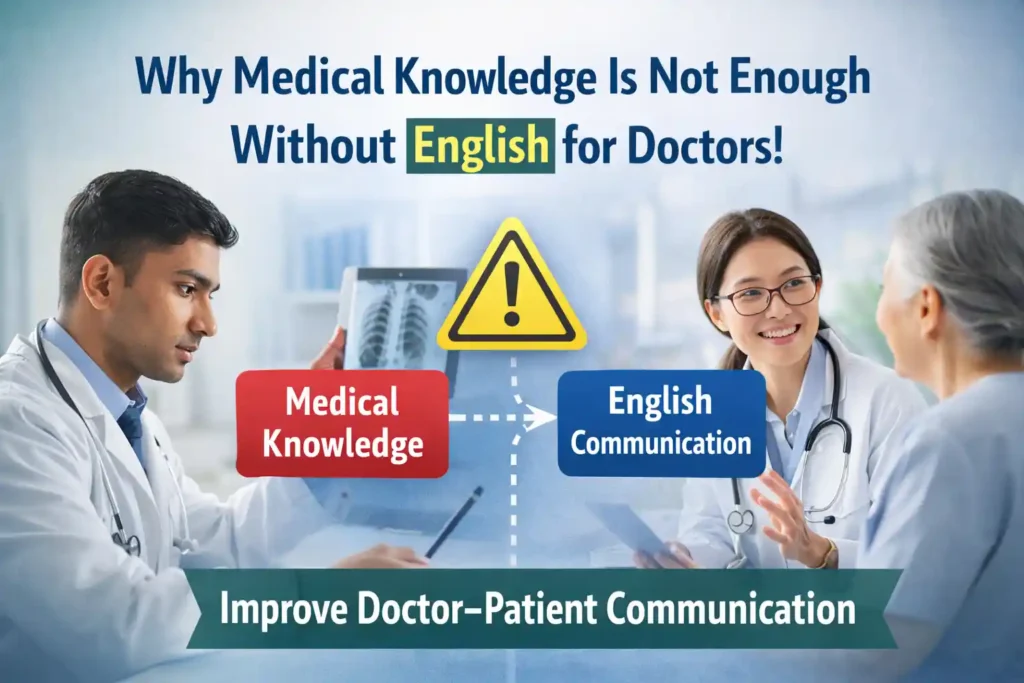
Medical knowledge is the foundation of a successful doctor, but in today’s global and patient-centered healthcare system, medical expertise alone is not enough.
English has become an essential communication tool for doctors—whether they are working in hospitals, clinics, telemedicine platforms, or dealing with international patients.
Many highly qualified doctors struggle not because they lack medical skills, but because they cannot communicate confidently in English.
The Reality of Modern Medical Practice
Today, doctors are expected to:
Explain diagnoses clearly
Discuss treatment plans
Communicate with patients from different backgrounds
Read medical research and guidelines
Interact with international colleagues
Most of this communication happens in English.
Without strong spoken English skills, even the most knowledgeable doctors can face serious challenges.
Why Medical Knowledge Alone Is Not Enough
1️⃣ Doctor–Patient Communication Matters More Than Ever
A doctor may know the correct diagnosis, but if they cannot explain it clearly in English:
Patients feel confused
Trust is reduced
Compliance with treatment decreases
Clear English communication helps doctors:
Build trust
Reduce misunderstandings
Improve patient satisfaction
2️⃣ English Builds Patient Confidence
Patients often judge a doctor not only by treatment results, but by:
How confidently the doctor speaks
How well the doctor listens and explains
How comfortable the consultation feels
Doctors who speak English confidently appear:
More professional
More reliable
More approachable
3️⃣ International Patients & Telemedicine
With the rise of:
Medical tourism
Online consultations
International healthcare platforms
Doctors increasingly interact with non-local patients, where English is the common language.
Without English:
Opportunities are lost
Growth becomes limited
Global exposure remains unreachable
4️⃣ Medical English Is Different from General English
Many doctors say:
“I know English, but I can’t speak it confidently with patients.”
That’s because medical communication requires specific skills, such as:
Explaining symptoms in simple English
Discussing risks and side effects
Giving clear instructions
Showing empathy in the right words
Medical knowledge without spoken English creates a communication gap.
5️⃣ Career Growth & Professional Development
English is essential for:
Case presentations
Medical conferences
Research papers
Interviews and certifications
Doctors with strong English skills:
Get better career opportunities
Perform confidently in professional settings
Stand out in competitive environments
Common Problems Doctors Face Without English
Hesitation while speaking
Fear of making mistakes
Difficulty explaining complex terms simply
Lack of confidence during consultations
Avoiding English-speaking patients
These problems are not about intelligence, they are about practice and training.
Why Doctors Need Spoken English Training (Not Just Grammar)
Doctors do not need:
❌ Long grammar rules
❌ School-style English classes
Doctors need:
✅ Practical spoken English
✅ Real medical conversation practice
✅ Confidence-building sessions
✅ One-to-one guidance
That’s where spoken English training designed for doctors makes the real difference.
A Practical Solution for Doctors
Many doctors today prefer online spoken English courses that are:
Flexible with hospital schedules
Focused on speaking, not theory
Personalized to medical professionals
A well-structured 1-on-1 online spoken English course for doctors helps:
Improve fluency
Build confidence
Communicate naturally with patients
How Doctors Can Improve Their English Effectively
The most effective approach includes:
1-on-1 live speaking practice
Medical conversation role-plays
Vocabulary used in real consultations
Gentle correction without judgment
This method allows doctors to improve quickly and confidently without pressure.
Final Thoughts
Medical knowledge saves lives, but communication builds trust.
In today’s healthcare world:
A good doctor needs both medical expertise and strong English communication skills.
Doctors who invest in spoken English do not just improve language—they improve their professional image, patient relationships, and career growth.
For doctors looking for 1-on-1 online spoken English training designed specifically for medical professionals, institutes like Digital Tutor Club follow a personalized, confidence-focused approach that fits busy medical schedules.